MixPT: Point Transformer with
Interleaved Window and Global Attention

1Seoul National University, 2Massachusetts Institute of Technology
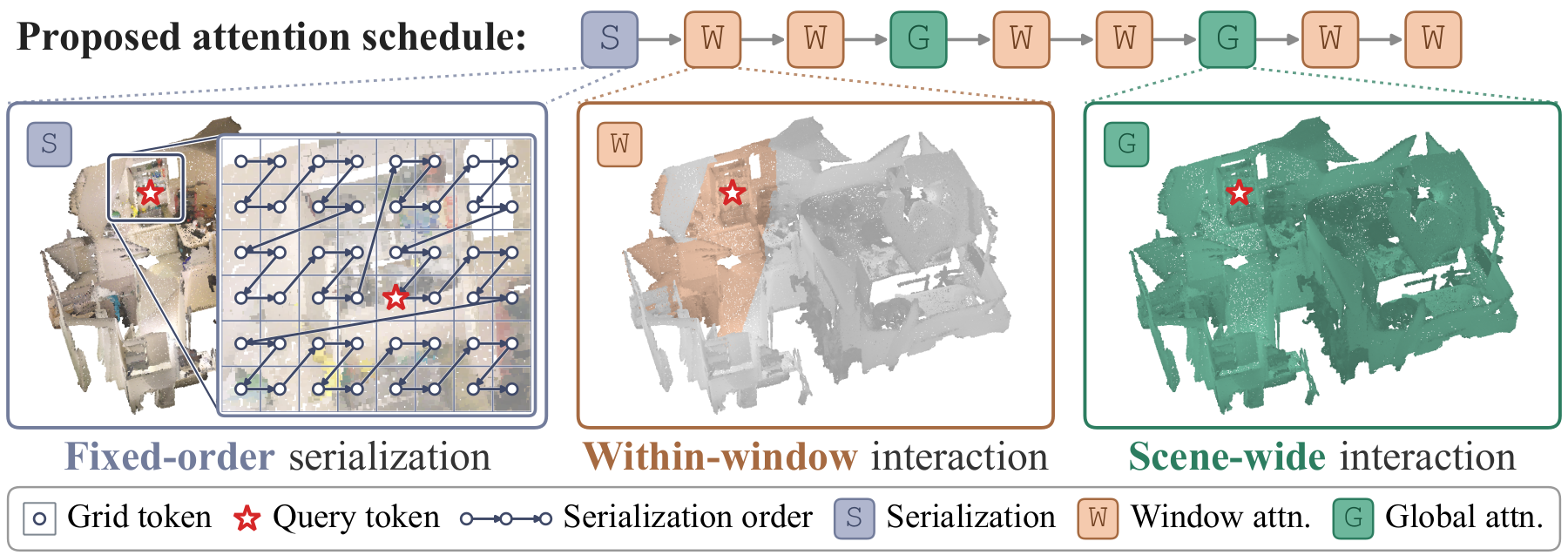
MixPT serializes a point cloud once, then alternates fixed-window interaction and scene-wide interaction in a WWGWWGWW attention schedule.

Serialize once, mix window and global attention.
MixPT-S serializes tokens once (S) and reuses that order throughout its WWGWWGWW attention schedule.

Abstract

Point cloud transformers aim to capture detailed local geometry and relationships across a scene at a manageable computational cost. Two common approaches are window attention and global attention. They differ in how they enable scene-wide interaction, which refers to information exchange among tokens across a scene. Window attention reduces computational cost by restricting self-attention to groups of tokens called windows; in serialized designs, each window contains a fixed number of consecutive tokens from a spatially ordered sequence. Because each block only directly connects tokens within the same window, information exchange across windows relies on changes in window membership across blocks and hierarchical pooling. Global attention, in contrast, directly connects all tokens within a scene, but computing attention over all token pairs can be costly when the number of tokens is large. To balance computational cost and scene-wide interaction, we introduce MixPT, a point transformer that uses a mix of window and global attention blocks in an interleaved schedule, while retaining a single fixed serialization pattern for its window blocks. For scenes with a large number of tokens, MixPT applies global attention to spatially pooled tokens and returns residual updates to the original-resolution stream. Across indoor and outdoor benchmarks, MixPT achieves competitive accuracy with lower latency than representative window and global attention baselines. We further demonstrate the feasibility of scaling the attention stage in depth by repeating the interleaved pattern of window and global attention blocks.
Preliminaries: Revisiting Window and Global Attention

1. Revisiting Window Attention

Window attention reduces computational cost by restricting self-attention to groups of tokens called windows; in serialized designs, each window contains a fixed number of consecutive tokens from a spatially ordered sequence. Because tokens in different windows cannot interact directly, serialized window transformers rely on changes in serialization pattern and hierarchical pooling for cross-window communication. Alternating the serialization pattern changes window membership across blocks, while hierarchical pooling aggregates information at coarser resolutions.

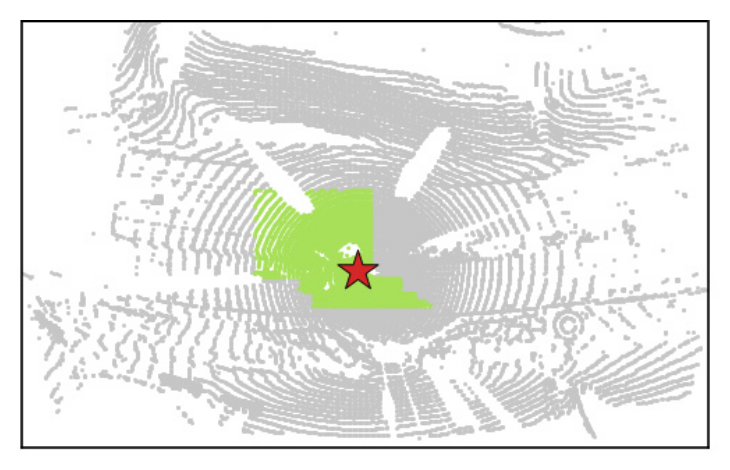
Tokens reachable from the selected query after LitePT attention block 1, using Z serialization.
Attention Block 1 · Z
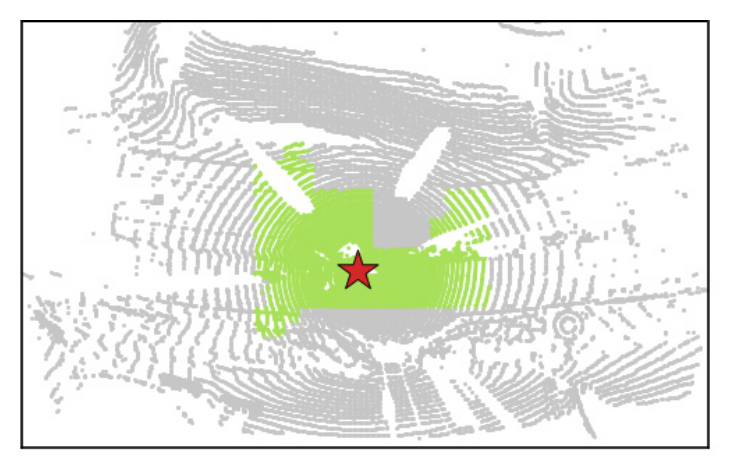
Tokens reachable from the selected query after LitePT attention block 2, using TZ serialization.
Attention Block 2 · TZ
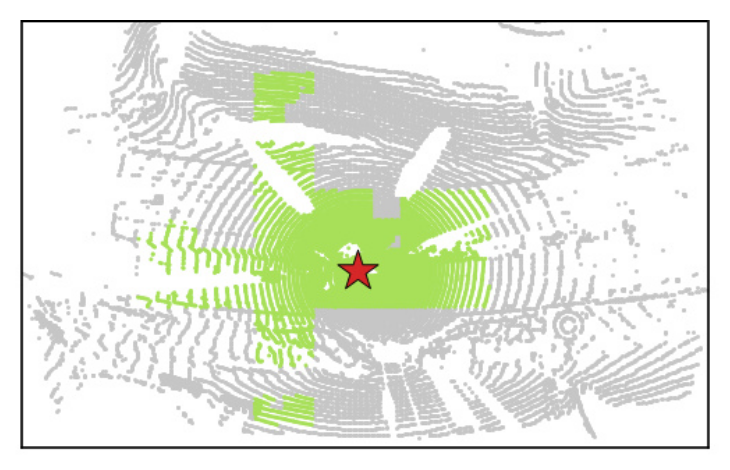
Tokens reachable from the selected query after LitePT attention block 3, using H serialization.
Attention Block 3 · H
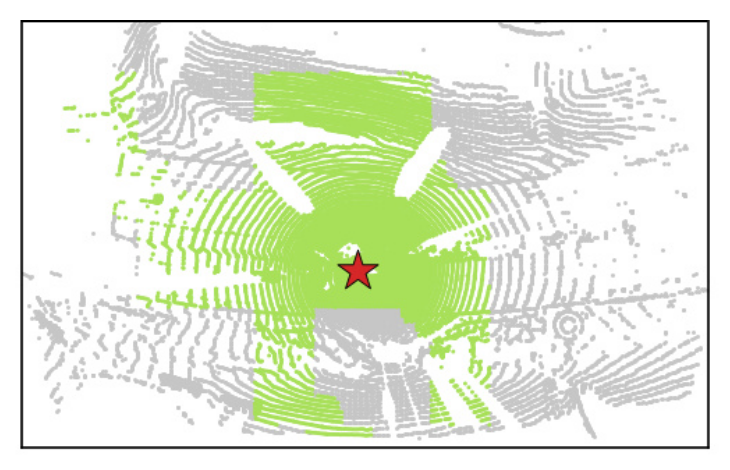
Tokens reachable from the selected query after LitePT attention block 4, using TH serialization.
Attention Block 4 · TH
Tokens reachable from the selected query after LitePT attention block 5, using Z serialization.
Attention Block 5 · Z

Information propagation through the first five blocks of encoder stage 3 of LitePT.
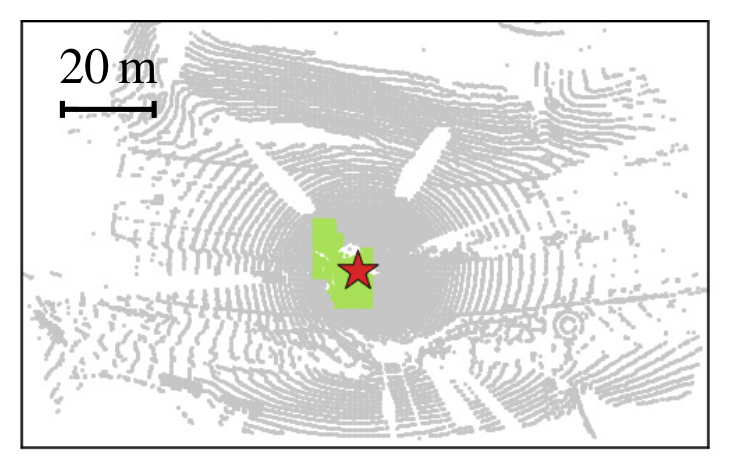
Green marks tokens reachable from the red-star token; gray marks those not yet reached.

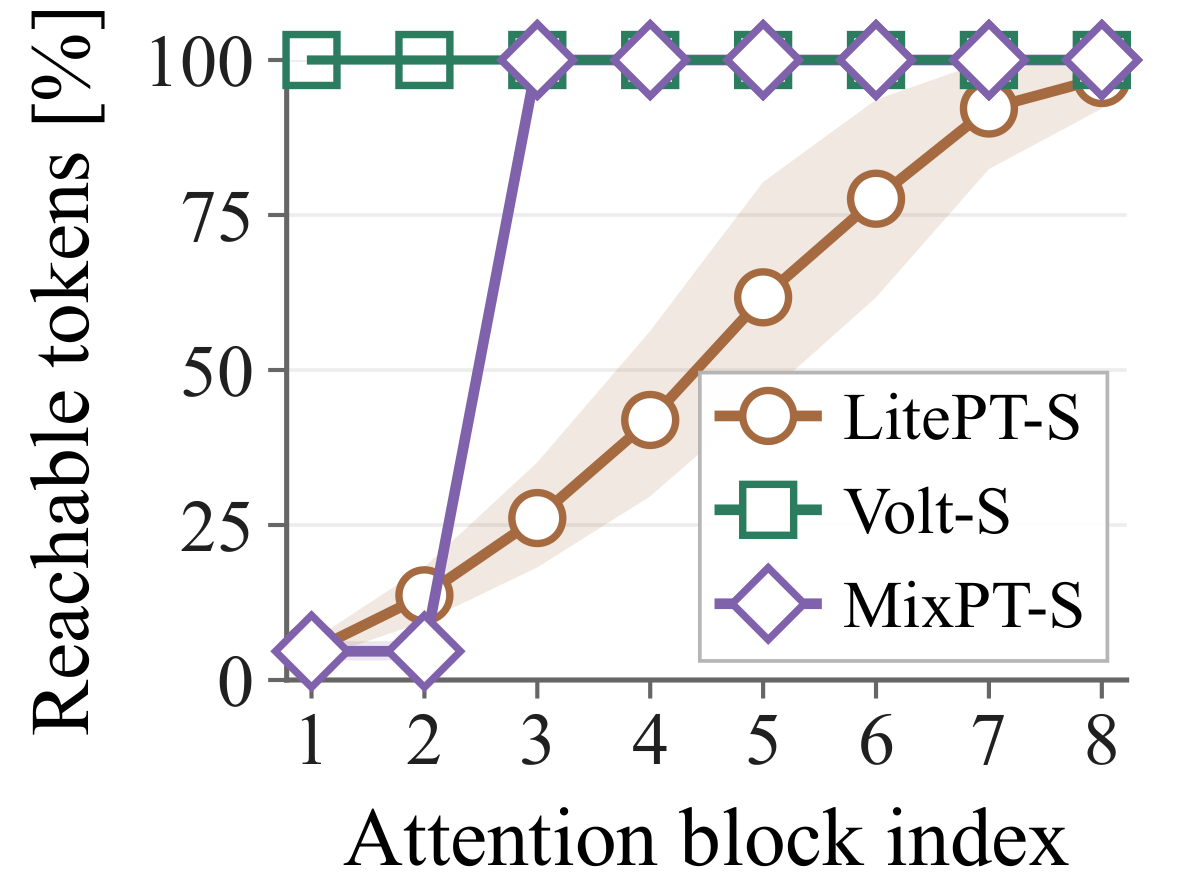
Structural token reachability on Waymo: LitePT-S expands gradually, Volt-S reaches all tokens from block 1, and MixPT-S reaches all tokens at its first global block, block 3.
Structural reachability across blocks.

Here, a token is considered reachable if it can be connected to the selected token through preceding attention blocks and hierarchical pooling transitions. We measure this structural reachability from the attention stage input tokens, excluding receptive fields accumulated in the preceding convolutional stages.

LitePT-S did not achieve 100% mean token reachability on the Waymo validation set even in its deepest attention blocks. In contrast, Volt-S has full structural reachability from its first block. These observations motivate introducing global attention early in the stage to establish full structural reachability. MixPT-S therefore places its first global block after two window blocks, while retaining a fixed serialization for its window blocks.

2. Revisiting Global Attention

Global attention achieves full structural reachability, but we ask whether its weights are also broadly distributed across tokens in every block. To this end, we analyze a) how concentrated attention is within each block and b) where a selected query assigns its attention within the scene.

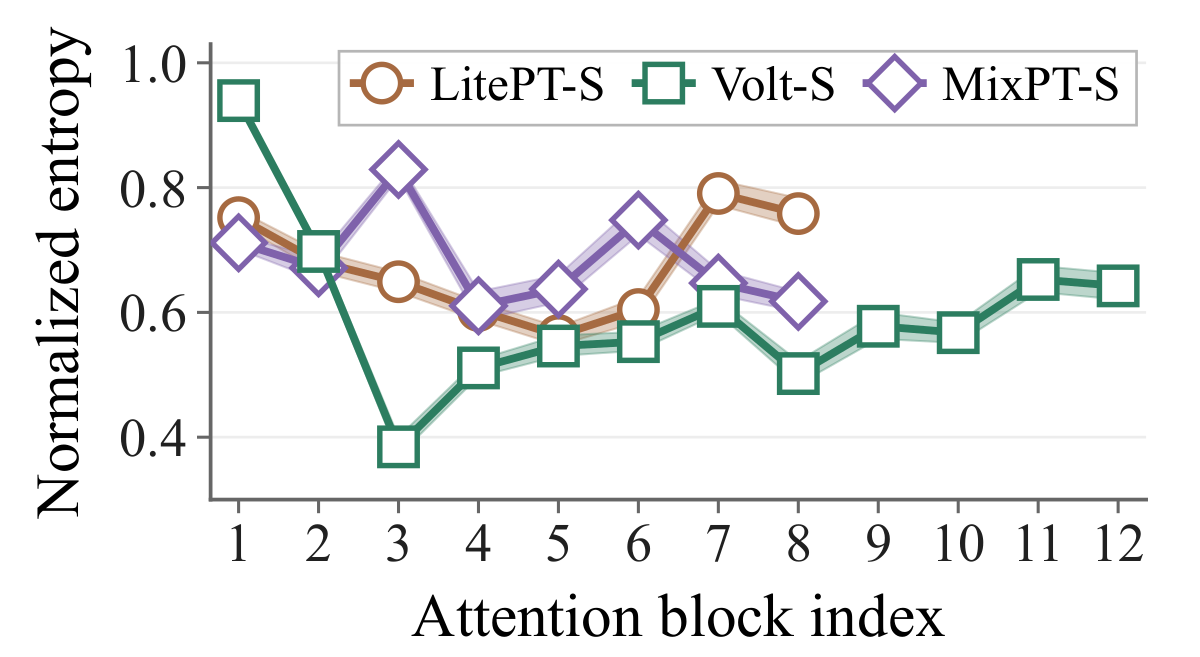
First, normalized attention entropy measures how evenly a query distributes attention over the keys it can attend to: a value of one indicates uniform attention over the available keys, while lower values indicate greater concentration on a subset.

The figure shows higher entropy in the early Volt-S blocks and lower entropy in several later blocks, indicating that the concentration of attention varies across depth.

Normalized attention entropy for LitePT-S, Volt-S and MixPT-S across blocks on Waymo; Volt-S is broadly distributed in its first block and more concentrated in several later blocks.

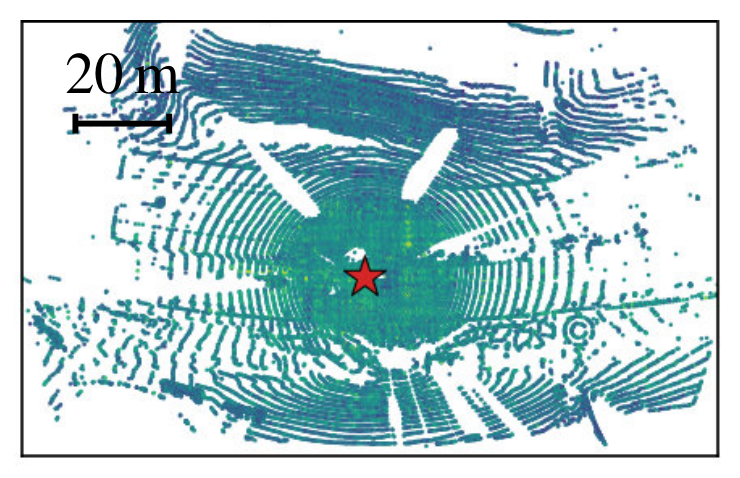
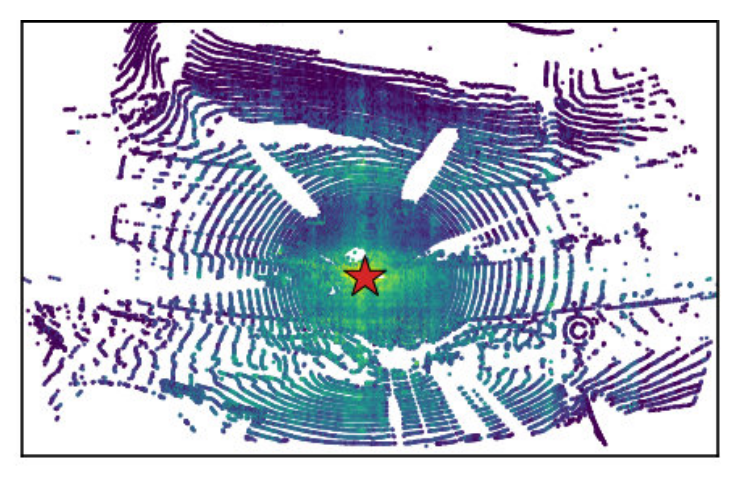
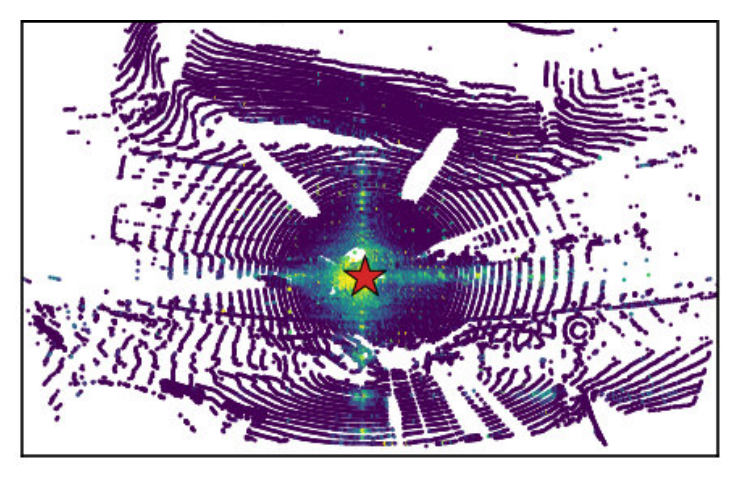
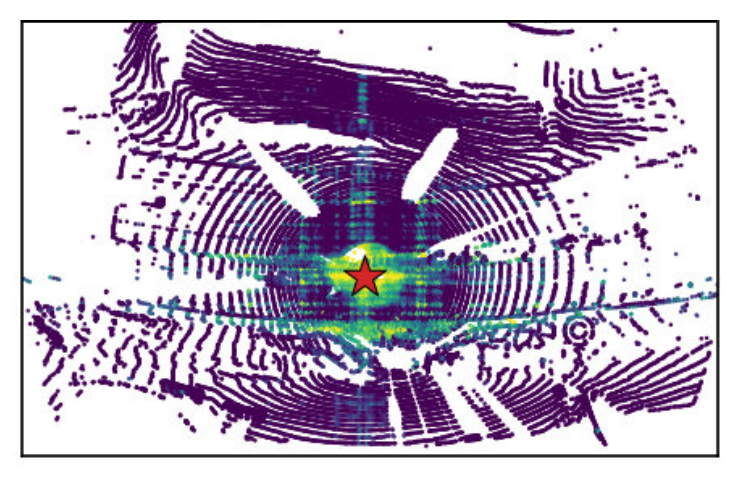
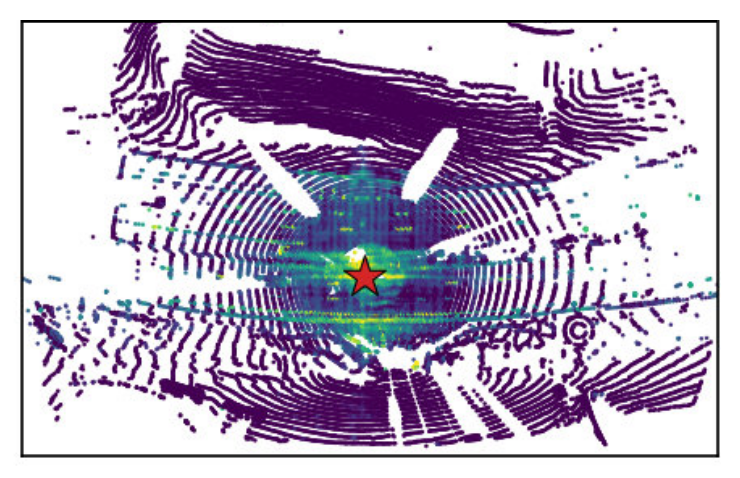
Second, we visualize the relative attention weights for a selected Volt query to show where attention concentrates within each block. Although each block allowed global interactions, attention for this query tended to concentrate on localized regions in later blocks.

Relative attention weights for the same selected query in Volt attention block 1.
Attention Block 1
Relative attention weights for the same selected query in Volt attention block 2.
Attention Block 2
Relative attention weights for the same selected query in Volt attention block 3.
Attention Block 3
Relative attention weights for the same selected query in Volt attention block 11.
Attention Block 11
Relative attention weights for the same selected query in Volt attention block 12.
Attention Block 12
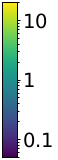
Color scale for relative attention weight.
Rel. attn.

Attention patterns across Volt blocks on the Waymo validation set.
Values of 1 and 10 indicate weights equal to and ten times the uniform weight, respectively.

These two key observations motivate the periodic use of global attention in MixPT-S for direct cross-window information exchange without computing attention between all token pairs in every block.

LitePT · Attention reachability

Loading point cloud…

Reachable Not yet reached Selected token

Volt · Attention weights

Loading point cloud…

Rel. attn.
Selected query